
Prepare to explore one of the hidden treasures, south of Marrakech’s medina: the Bahia Palace. From your very first visit, you’ll quickly understand why this monument fascinates so many travellers. Here, every corridor, every courtyard feels like stepping into a new story where the finesse of Moroccan art is expressed without restraint.
Visiting the Bahia Palace in Marrakech: The Essentials at a Glance
- The Bahia Palace in Marrakech is a Moroccan architectural treasure, an emblem of Islamic art. It fascinates with its courtyards, lush gardens, and the richness of its zellige tiles, stucco, and woodwork.
- Discover the history of this opulent 19th-century residence, built for Vizier Si Moussa and later extended, symbolising the power and refinement of artisan craftsmanship.
- Plan an optimal visit with practical advice on access, opening hours, budget, and sites to combine. It’s a unique immersion into Moroccan cultural heritage.
Why is the Bahia Palace a Must-Visit in Marrakech?
It’s hard to talk about Marrakech without mentioning the Bahia Palace (Bahia Palace). For many, it embodies the best of Islamic architecture, blending tradition and innovation. Its beauty lies not only in the magnificent photographs one can take there but, more importantly, in the unique emotion it evokes as you stroll through its rooms and shaded gardens.
This monument, located near the medina, stands out from other Moroccan palaces due to the diversity of its spaces and its importance in local history. Children often enjoy wandering from room to room without ever getting tired. As for adults, they readily find inspiration observing the refinement of the zellige tiles, stucco, and woodwork sculpted by talented artisans. (More about Marrakech with your family)
The History of the Bahia Palace: A Witness to the 19th Century
This construction was initially for Vizier Si Moussa, the Grand Chamberlain of Sultan Hassan I; the history of the Bahia Palace begins at the end of the 19th century. His ambition was to create an opulent residence. A few years later, his son, Abu Ahmed Ben Moussa, who became Grand Vizier under the reign of Moulay Abdelaziz, considerably enlarged and embellished the complex between 1894 and 1900. He entrusted the work to artisans from all regions of Morocco.
The objective was to make the Bahia not only an imposing residence but also a dazzling symbol of power and refinement. It is said that the palace was designed for one of the vizier’s favourites, “La Brillante”, hence the name “Bahia”, meaning “the beautiful” or “the brilliant” in Arabic. Beyond this legend, it remains a living testament to the beauty of Moroccan architecture and the talent of its decorators. (descubre la historia de Marrakech)
Wonders to Discover at the Bahia Palace
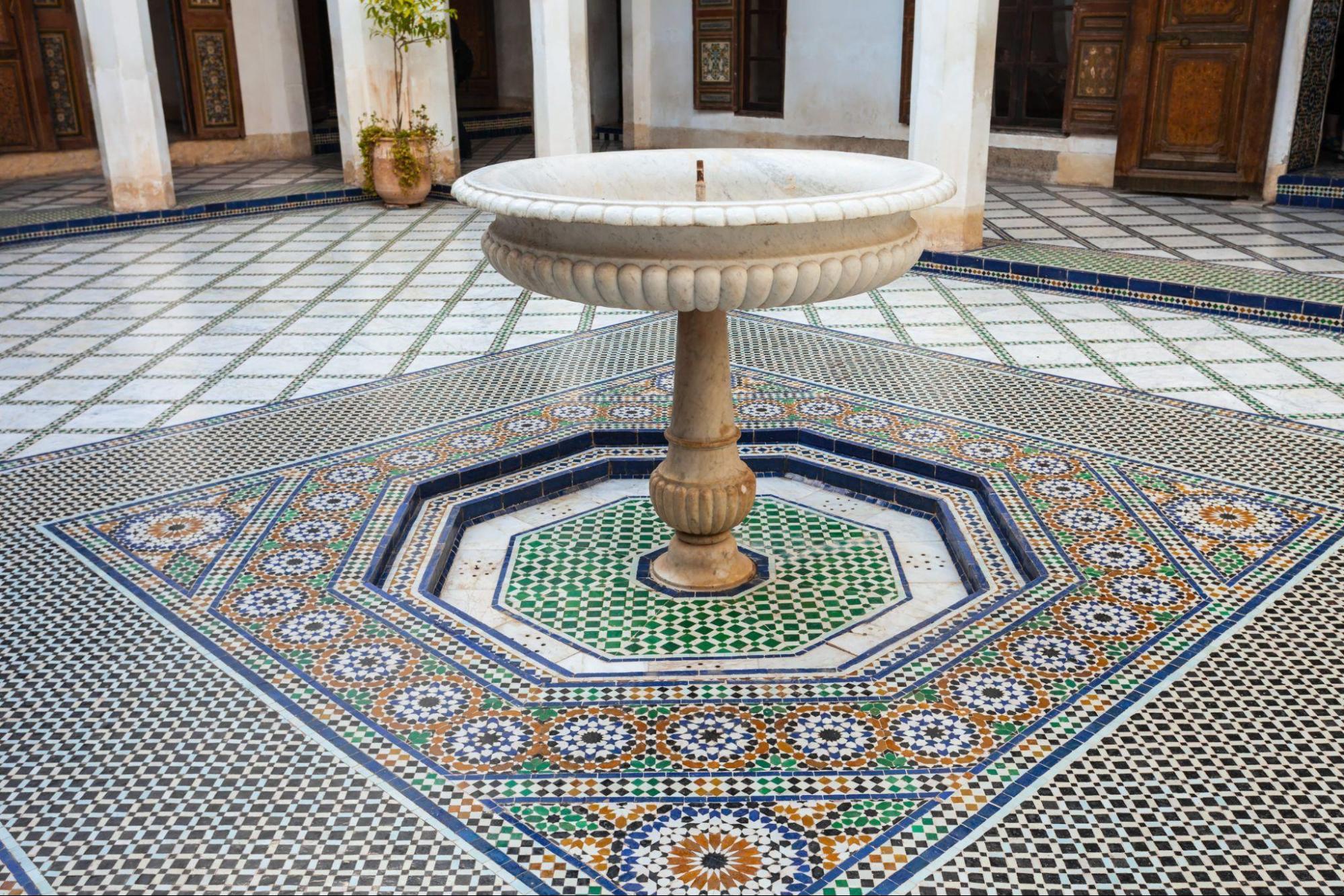
A visit to the Bahia Palace offers a mosaic of unique spaces. The Palace’s spaces were built, decorated, and furnished by the country’s best artisans of the time, with successions of courtyards, salons, rooms, a mosque, harem, hammam, gardens…
Here are some highlights not to miss:
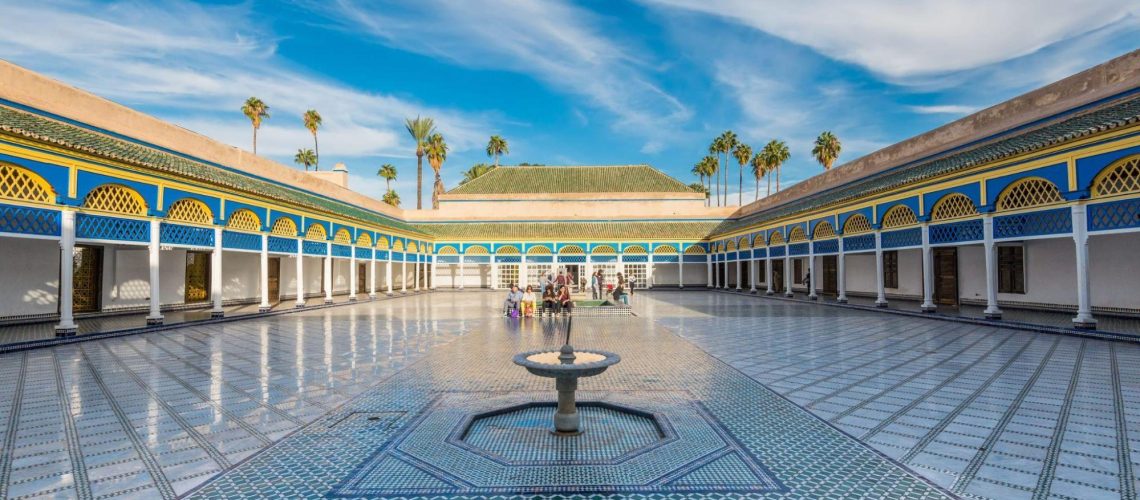
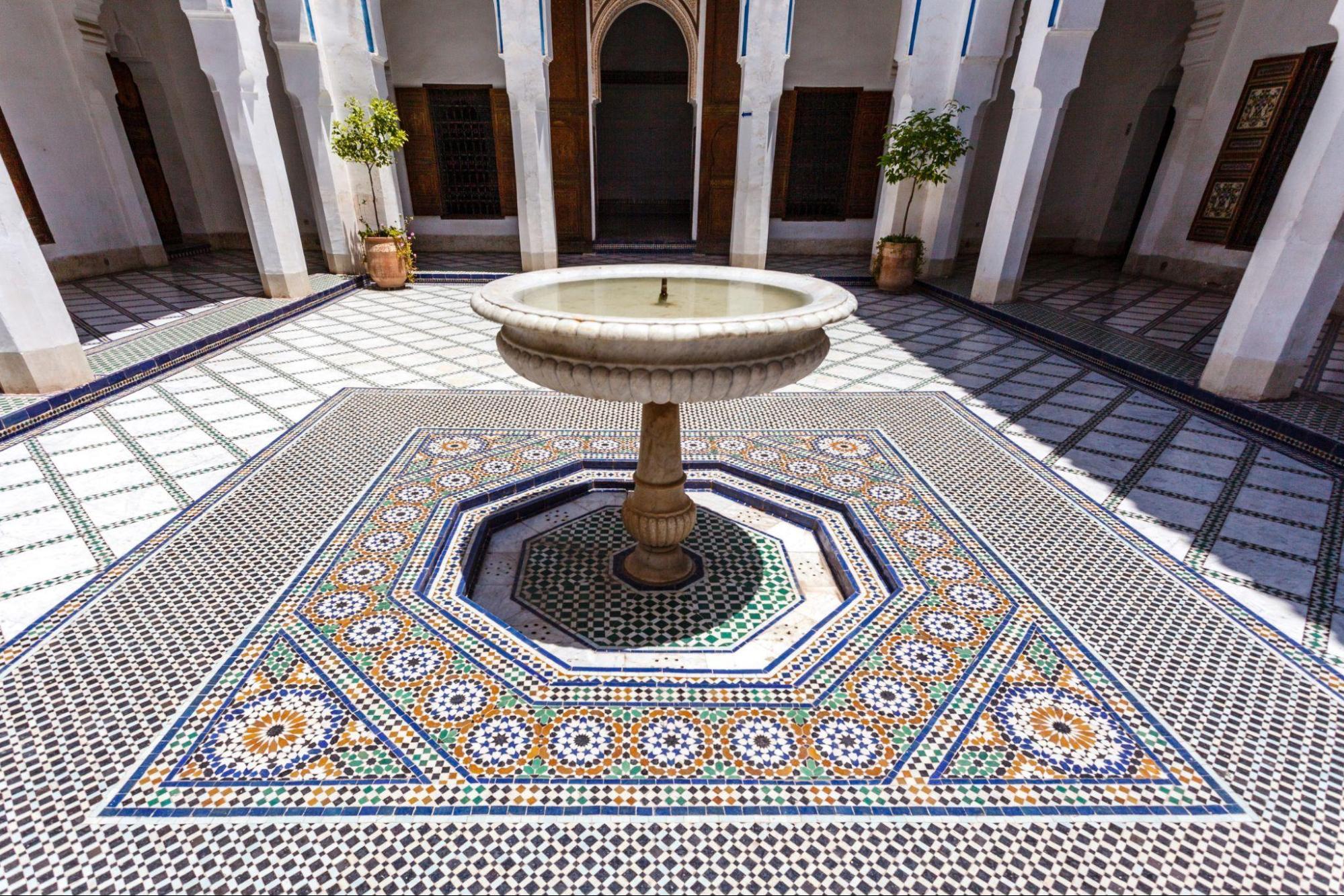
* The Grand Central Courtyard: Its white Carrara marble floor and galleries lined with sculpted columns offer a striking spectacle at any time of day.
* The Grand Riad: With its vast central basin and four Andalusian-style gardens, it’s a haven of coolness and serenity.
* The Salon d’Honneur (Hall of Honour): Here, the richness of the painted cedar wood ceilings and the precision of the sculpted plasterwork pay homage to traditional Moroccan art.
* The Private Apartments: Their intimacy and meticulous details reveal daily life within a 19th-century Moroccan palace, often with smaller interior patios and fountains.
* The Lush Gardens: True oases, they offer shade under orange trees, cypresses, and palm trees, while the murmur of the fountains adds a welcome touch of coolness.
Each space is enhanced by massive doors, ogival windows, and a symphony of colours that recalls the best of Moroccan cultural heritage. The pathways are generally well-marked, making the visit enjoyable even with children. Allow at least one to two hours to fully appreciate every detail, without rushing.
The Gardens of the Bahia Palace: An Enchanting Interlude
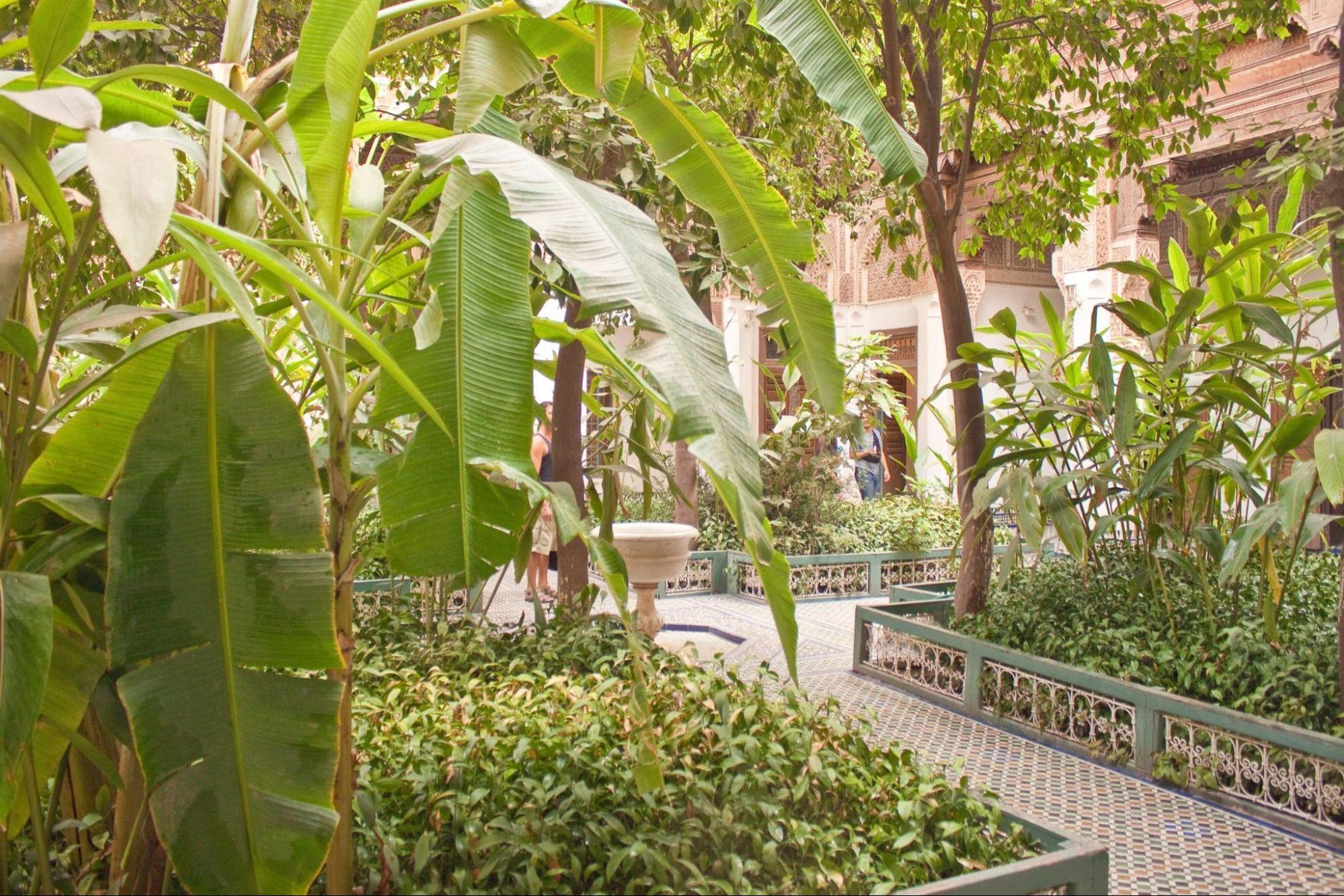
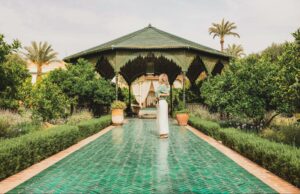
The gardens of the Bahia Palace provide an immediate sense of serenity. As soon as you cross the threshold, you are enveloped by the tranquillity of the place. The gentle sound of water from the fountains soothes the mind, while the carefully planted fruit trees offer shade and intoxicating scents. The flowerbeds compose a living tableau, inviting contemplation. (read about palm groves)
These green spaces, organised around basins and paved pathways, perfectly illustrate the fundamental place of nature in Moroccan architecture and Islamic art, symbolising paradise on earth. Families often like to settle there, enjoying a breath of fresh air away from the bustling streets of the medina. You won’t fail to notice the care taken in the plant composition, inherited from a long tradition of artisan craftsmanship.
The Palace Architecture: A Homage to Artisan Craftsmanship
You don’t need to be an art history expert to appreciate the architecture and meticulous detail displayed in every corner of the palace. Whether through the painted cedar wood ceilings, delicate mouldings, or floors covered in zellige tiles, everything here celebrates Moroccan craftsmanship. Geometric and floral motifs intertwine, telling silent stories inherited from centuries of traditions. (More about zellige tiles here)
Zellige tiles are geometric ceramic tiles, glazed and hand-cut, forming intricate mosaics. Stucco is a plaster-based coating, sculpted into fine and calligraphic motifs, often on walls and arches.
Our tip: pay attention, as restoration artisans sometimes share their passion for these art trades during your visit. These rare encounters can add a human and fascinating dimension to your discovery of the monument. (More about slow travel in Marrakech)
Practical Information for Your Visit to the Bahia Palace
Located south of the Medina, the Bahia Palace is easily accessible from Marrakech’s medina. On foot, allow between ten and twenty minutes from Jemaa el-Fna square, depending on your pace and that of your children. You can also take a taxi from any district like Guéliz, which can be useful if you’re carrying things for the little ones. (Más sobre la Medina de Marrakech)
As with many museums and emblematic sites, it’s best to opt for a visit early in the morning (as soon as it opens) or late in the day (one to two hours before closing). These slots avoid crowds and allow you to enjoy beautiful natural light that highlights the abundant details of the interior decoration. The Bahia Palace is open to the public every day from 9 am to 5 pm, except during Ramadan (from 10 am to 4 pm). Always remember to check opening hours.
What Budget to Plan for Visiting the Bahia Palace?
The entrance fee is 100 MAD per adult (approximately 9 euros). A reduced rate is often applied for children (approximately 30 MAD). Don’t hesitate to check current prices before your visit, especially if you wish to hire a guide.
Remember to bring some small change to buy water or perhaps an artisan souvenir from the vendors present around the site. There is no official shop inside the palace, so you can wander at your own pace, without fear of being approached.
Some Useful Recommendations:
* Comfort: Wear comfortable shoes, as you’ll be walking a lot and the floors can be uneven.
* Sun Protection: Take a hat or cap, especially if visiting midday, and sun cream. Even if some parts are shaded, the journeys to the palace can be in full sun.
* Hydration and Snacks: Bring a bottle of water and some snacks, as no refreshments are offered inside.
* Local Guide: Don’t hesitate to hire an accredited local guide if you wish to delve deeper into the history or gain unique insights into Moroccan art. The cost of a guide can be negotiated at the entrance for an enriching experience.
* Accessibility: The palace has numerous courtyards and steps. It is partially accessible to prams and wheelchairs in the main courtyards, but many rooms and inner gardens can be difficult to access.
The Bahia Palace: An Immersion in Moroccan Cultural Heritage
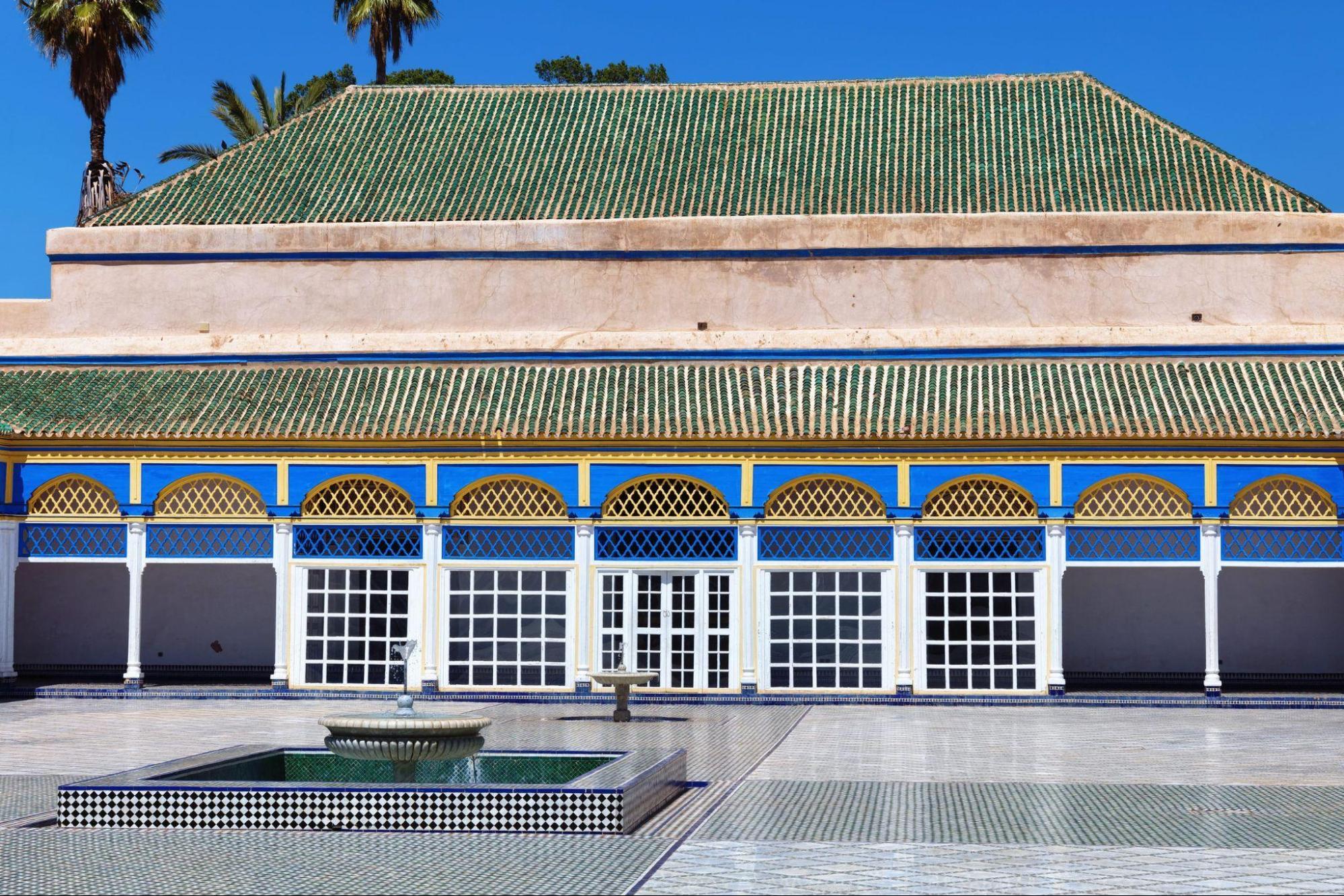
While the Bahia Palace evokes grandiose oriental architecture, it stands primarily as a place of life and history. Its open halls bear witness daily to the vitality of Moroccan cultural heritage, oscillating between history and modernity.
Although not a museum in the traditional sense, the palace occasionally hosts artistic events or temporary exhibitions, thus offering an opportunity to combine architectural discovery with an immersion into local contemporary or traditional art. It’s a place that allows everyone, including children, to connect with the richness of Moroccan architecture and the secrets of ancient artisans.
What Souvenirs to Bring Back from the Bahia Palace?
After exploring this masterpiece, it’s tempting to leave with an item recalling the finesse of local artisan work. As mentioned, you won’t find an official shop within the monument’s grounds, but the surroundings abound with small stalls offering:
* Decorative items inspired by the palace’s interior decoration: inlaid mirrors, colourful wrought-iron lanterns, small Berber rugs.
* Authentic zellige tiles (often sold individually for decoration) or hammered metal teapots, perfect souvenirs to slip into your suitcase.
* Products from the broader local craftsmanship such as natural soaps, ceramics with Moroccan motifs, and colourful textiles.
These little finds, at varied but accessible prices, always delight friends and extend the magic of the visit once you’re back home. You can also find them in the souk.
Combining a Visit to the Bahia Palace with Other Major Sites
Located in the heart of the medina, the Bahia Palace is ideally situated to be combined with other historical treasures of Marrakech. You are close to the Saadian Tombs, Ben Youssef Madrasa, and the El Badi Palace.
An excellent tip is to plan your itinerary for half a day, including two or three major monuments according to your pace and interests. By opting for walks or side-car rides, displacements transform into fascinating discoveries where every alley reveals a piece of Moroccan history or art.
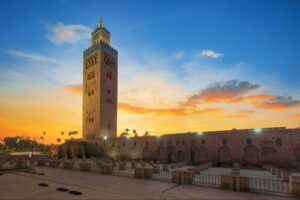
To continue your discovery of Islamic art, don’t miss the Confluences Museum (Dar al Bacha) or the Koutoubia Mosque. Enough to satisfy everyone’s curiosity and make your day in Marrakech a memorable one. We can also help you organise these thematic tours.
Strolling through the Bahia Palace means letting yourself be surprised at every turn by the creativity of Moroccan architecture and the poetry of its gardens.